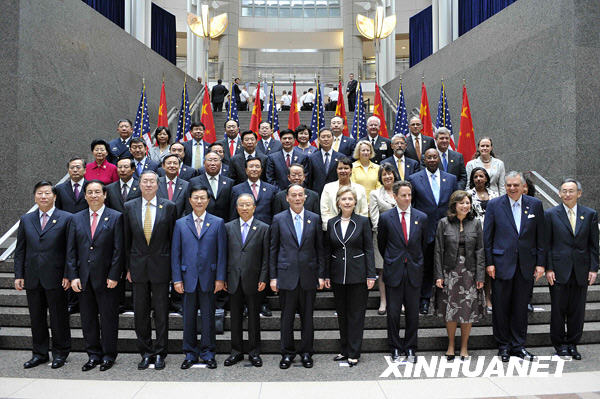
On July 27, 2009, the first meeting of the Strategic and Economic Dialogue (S&ED) between the United States and China opened in Washington D.C., capital of the United States. The meeting was chaired by Chinese Vice Premier Wang Qishan and State Councilor Dai Bingguo, who are President Hu Jintao's Special Representatives, and U.S. Secretary of State Hillary Clinton and Treasury Secretary Timothy Geithner, who are President Barack Obama's Special Representative.
Wang Qishan and Dai Bingguo addressed the opening session respectively. Wang first read out the message of President Hu Jintao, in which President Hu pointed out that China and the United States, as two countries with significant influence in the world, shoulder important responsibilities on a host of major issues concerning peace and development of mankind and share extensive common interests and wide space for cooperation. China and the United States, in the face of the complex and volatile international economic and political situation, should strive to expand common ground, reduce differences, enhance mutual trust and strengthen cooperation through the Strategic and Economic Dialogue. This serves the common interests of the two sides and also helps advance the positive, cooperative and comprehensive relationship between our two countries. It is also of great importance to the peace, stability, development and prosperity of the whole world.
Wang Qishan said that the important consensus reached by the two heads of state is to work together to develop a positive, cooperative and comprehensive relationship between China and the U.S. in the 21st century. The core is to strengthen cooperation and the time horizon is the 21st century. This S&ED is an important reflection of the consensus. We are also aware of the great responsibility on our shoulder. In accordance with the requirements of the two heads of state, we need to make full use of the platform of this Dialogue to promote consensus, strengthen mutual trust, expand common interests and strive to reach more mutually beneficial and win-win results.
Wang pointed out that the global economy is in a critical period of moving from crisis to recovery. In the S&ED, the two sides will focus on the theme of "Strengthening the Confidence in Restoring Economic Growth and Enhancing the China-U.S. Economic Cooperation" and increase the exchange of views on important topics such as coping with the international financial crisis, building a strong financial system, deepening trade and investment cooperation, and promoting sustainable economic development. The two sides will once again send out a positive signal that China and the United States are working together in the face of the current hard times to resume the economic growth of the two countries and even the world at large. From a historical and philosophical point of view, mankind's pursuit for peace, development, prosperity and civilization will never change and they will always progress in the fight against all kinds of difficulties. "I believe the crisis will pass eventually."
Wang stressed that China is speeding up industrialization and urbanization and the Chinese market has great potentials. "We will continue to implement the scientific outlook on development, deepen reform, expand opening-up, and take a holistic approach toward responding to the current financial crisis, maintaining stable and rapid economic growth, advancing structural adjustment and transforming the mode of economic development so as to achieve better and faster growth of the national economy. A more open and dynamic Chinese economy will bring enormous development opportunities for all countries in the world including the United States. As China's reform and opening-up drive moves deeper, the economic and trade cooperation between China and the U.S. will be more closely linked and China-U.S. relations are bound to move forward from a new starting point."
Dai Bingguo said that during the London summit in April this year, President Hu Jintao and President Obama decided to establish the China-U.S. Strategic and Economic Dialogue. The first meeting opened today. This is a happy event worth celebrating and rejoicing in the China-U.S. relations. The Chinese side is willing to have frank and in-depth dialogue with the U.S. side in the spirit of mutual respect, equality, mutual benefit and win-win results on the China-U.S. bilateral relations and other macro, strategic and forward-looking issues that involve human survival, peace, and development, explore how to build a positive, cooperative and comprehensive China-U.S. relationship in the rapidly changing 21st century, and seek to increase understanding, deepen mutual trust, expand consensus, develop cooperation and make the cake of common interests bigger and sweeter so as to benefit the peoples of both China and the United States and the home earth, where we live together.
Dai pointed out, "I would like to look at the future of China-U.S. relations with optimism. After 30 years of concerted efforts, the China-U.S. relationship has seen great progress. Interactions and communications between China and the United States have never been as frequent as it is now. The convergence of interests between China and the United States has never been as close as it is now. The mutually beneficial cooperation between China and the United States has never been as broad as it is now. The driving force for the development of China-U.S. relations has never been as strong as it is now. Our two great nations and peoples have every reason to firmly seize the historical opportunity to enhance strategic mutual trust, expand comprehensive cooperation, properly handle differences and sensitive issues, and work together to create a better future for China-U.S. relations."
Hillary Clinton and Timothy Geithner also addressed the meeting. Clinton said that the Strategic and Economic Dialogue is a new beginning, marking that the U.S. and China are making unprecedented efforts to lay a foundation for the positive, cooperative and comprehensive U.S.-China relationship in the 21st century. The United States and China face common global challenges, which require joint efforts of the two sides.
Clinton said the Obama Administration is committed to having more extensive engagements with China to resolve regional and global issues. The United States welcomes the great achievements of China in economic development and the active efforts of China to maintain peace and stability in the Asia-Pacific region.
Clinton said that the dialogue mainly covered the following areas: first, promoting economic growth. Both sides agree that economic and financial cooperation needs to further strengthened, which will be conducive to global economic recovery; second, climate change and clean energy; third, security challenges. The U.S. side appreciates the important role played by China on the Korean Peninsula nuclear issue in the six-party talks process; and fourth, the issue of development. To deal with common challenges in the 21st century, the United States and China need to seek for further consensus.
Geithner said that the joint response to the international financial crisis is a turning point in the US-China cooperation. The powerful measures taken by the United States have rebuilt the confidence and released the message that the United States and China are on the same boat. Actions taken by the United States and China will not only benefit the two peoples, but also be conducive to global economic recovery. The financial crisis made us realize that the model of economic growth needs to be changed. The United States and China need to work closely together to ensure balanced and sustainable economic growth. Fundamental changes have taken place in the global economy from the establishment of the Bretton Woods system till today. The United States and China face major opportunities to restructure the global economic system and deal with the challenges.
Chinese President Hu Jintao and U.S. President Barack Obama agreed to establish the China-U.S. Strategic and Economic Dialogue during the London summit in early April and decided to have the first meeting of the S&ED in summer in the Washington D.C.